
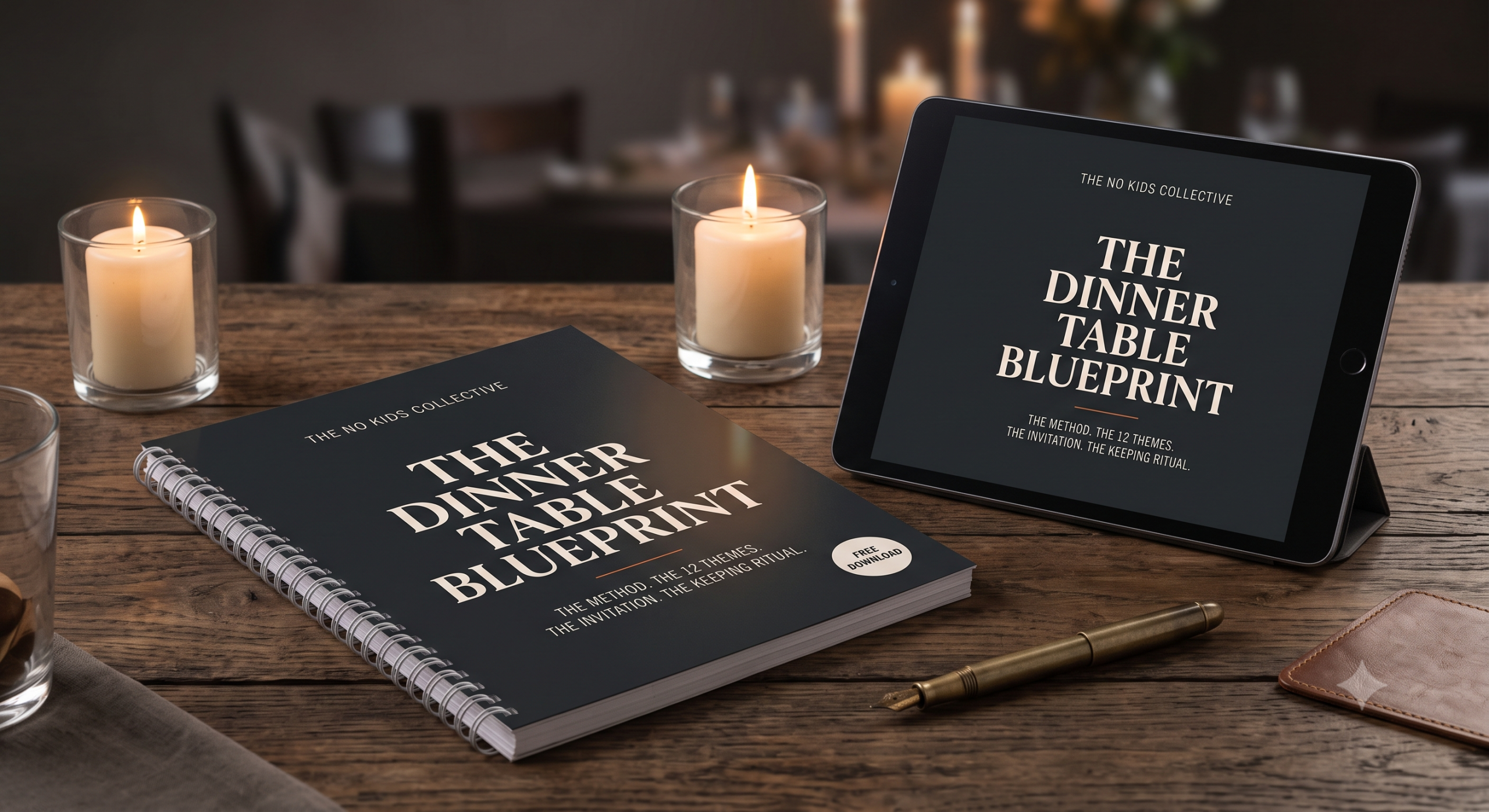
The dinner table
The No Kids Collective
I Host Six Dinner Parties a Year. This Is the Whole System.
Eleven years. Sixty-six dinners. The notes from every one.
Six times a year. Every two months. Always eight people.
The post about it traveled further than anything I have ever written, and the same question kept arriving in my inbox. Not “why do you do this.” People understood why the moment they read it.
The question was “how.”
So this is the whole thing. The system, the failures, the themes, the one ritual that turned dinner into a record of my life. It is longer than a caption. Making a thing like this takes longer than reading about it, and I want you to be able to actually build it.
The First One Failed
Nobody tells you this part.
My first dinner party, eleven years ago, was a disaster in the politest possible way. Twelve people, because I thought more was better. No theme, because I thought structure would feel forced. Two hours, because that is how long it took everyone to find a reason to leave.
Twelve people is not a conversation. Twelve people is three conversations happening over each other, and the quiet ones drown. I watched a woman I deeply admired spend the whole night nodding at a man who never asked her a question.
I almost did not do a second one.
The second one, I cut it to eight. Eight is the number where the table can hold a single conversation without anyone shouting and without anyone hiding. I did not invent this. Long before me, people who studied conversation for a living landed at the same range. I found it by embarrassment.
The second dinner went three hours. The third went four. I have not changed the number since.
The Mix Is the Machine
Here is the rule I follow when I choose the eight.
Someone I have known for decades. Someone I met last month. Someone from a different part of my life who does not know anyone else at the table.
That last one matters most. A table of old friends runs on shorthand and inside jokes, which is pleasant and goes nowhere new. One stranger changes the physics. Everyone explains themselves a little more. Old stories get told properly instead of referenced. The stranger asks the question nobody else would think to ask, because everybody else already knows the answer, or thinks they do.
I keep a running list on my phone of people who would be good at a table. Not important people. Good-at-a-table people. The friend who asks second questions. The coworker who tells a story with a beginning and an end. The neighbor who disagrees without heat.
When I am building a dinner, I pull from that list the way you would cast a play. Two talkers, maybe. Never three. At least one person who listens the way other people talk, actively, like it is their turn.
And I never explain to anyone why they were chosen. Being chosen is the whole message.
The Theme Stays Sealed
There is always a theme. The guests do not know it until they sit down.
This is the part people push back on before they try it. It sounds like a corporate icebreaker. It is the opposite. An icebreaker is a stranger’s question asked too early. A theme is a door everyone walks through together after the wine is poured.
I reveal it after the first glass, before the main course. I say it once, plainly, and then I answer first. That is the host’s tax. You go first so that going honestly is the standard, and going safe feels like the odd choice.
Last February the theme was Things That Endure. We talked for four hours. Nobody checked a phone. A man who builds furniture talked about a joint that has held a chair together for ninety years, and a widow two seats down picked up the thread without a pause, and nobody needed it explained that she was not talking about chairs.
In April it was Things We Changed Our Minds About. A man who had been married three times said the same thing about all three. Nobody asked him to say more. He did anyway.
That is what eight people around a table can do.
Not because the question was clever. Because the room was set up right and the question had somewhere to land.
A good theme has three properties. Anyone can answer it from their own life without preparation. It has no correct answer. And it tilts personal without demanding confession. Things That Endure passes all three. What Do You Do For Work fails all three, which is why it is banned at my table.
I will give you five from my list, the ones that have never once failed.
THEME 01
Things That Endure
Objects, habits, loves, grudges. Everyone owns something that outlasted its explanation.
THEME 02
What You Would Go Back and Stay Longer In
Not what you would change. Where you rushed. The last time we ran this one, someone said they would go back and stay longer in all the places they hurried through, and I wrote it down the moment the door closed.
THEME 03
The Thing You Were Wrong About the Longest
This one needs a table that has warmed up. Save it for after the main course.
THEME 04
Something You Kept That You Should Have Thrown Away, or Threw Away and Should Have Kept
Every single person has one. Every single one is a story.
THEME 05
The Compliment You Never Forgot
Gentler than it sounds. People remember these for forty years, word for word, and most have never said them out loud.
The Rules of the Table
There are only three, and I never announce them. I just build the night so they enforce themselves.
No phones. I do not confiscate anything. There is simply nowhere to put one. The table is set close, the lighting is warm and low, and the host’s phone is visibly absent. Nobody wants to be the first screen glowing at a candlelit table. Environment beats enforcement every time.
Nobody leaves early. Also never announced. You get this by putting the reveal after the first glass and the best course late. People stay for the same reason they keep reading a good book. Something is still open.
Everyone gets found. This one is my job. If someone has gone quiet for twenty minutes, I do not put them on the spot. I hand them the thread. “You told me something about this once.” That is all it takes. The quiet ones are never empty. They are waiting to be asked properly.
The Invitation
People ask what I send. Word for word, this is it:
Every sentence is load-bearing. “One of my dinners” says this is a thing that exists and has history. The sealed theme is the hook that gets a yes from busy people. “I want you there” is the sentence people do not hear enough. It does the choosing out loud.
The Keeping Book
After everyone leaves, before I touch a single dish, I sit down and write one thing.
Not a summary. One thing said at the table that I do not want to lose. One sentence, usually. The date, the theme, the names, and the one thing.
Six times a year. Eleven years. That is sixty-six kept things, and reading the book back is like walking through every version of my life with the best people I knew at the time. Conversations from three years ago get referenced at this year’s table. People say “that goes in the book” when someone lands something true, and they say it like a toast.
I do not have a family dinner. I have this.
It is not a replacement and it is not a consolation prize. It is the thing I chose to build, on purpose, over years, and it has its own history now.
That is the part the post could not hold, and it is the part that matters. Anyone can cook for eight. The system is what turns a dinner into a record.
Start Smaller Than You Think
If you build one thing from this whole piece, do not start with eight.
Start with three. One theme, revealed at the table. Answer first yourself. Write down one thing after they leave.
That is a complete first dinner. The rest, the mix, the casting list, the sealed envelope, the sixty-six entries, grows from doing that once and noticing that four hours went by and nobody reached for a phone.
The Dinner Table Blueprint
The twelve themes that have never failed, each with the follow-ups that keep it going. The invitation, word for word. The keeping ritual, with the page. Free, because a caption can start a table but it cannot set one.
Get the Blueprint Free